

Itzia Crespo

Audio By Carbonatix
For Robert Gawlitza, the morning of Nov. 25 began just like any other.
He arrived for work at the Circle K he managed in north Phoenix, preparing for what he figured would be another in a series of routine days with the company. He’d worked for Circle K on and off since 2009, at locations all across the Valley and in Las Vegas. After a while in the employment of the gas station and convenience store giant, you’ve just about seen it all.
On the way in, one of his employees sent him a news report: A winning lottery ticket, worth $12.8 million, had been generated at this store. Huh, he thought to himself, that’s neat. In his 17 years with the company, his store had never sold a ticket that had won such a big jackpot. To play such a minor role in someone’s life-changing payday — a footnote to a footnote, given he wasn’t working when the ticket was printed — would make for a fun thing to mention in conversation.
Instead, Gawlitza has found himself at the center of one of the most intriguing lottery controversies in Arizona history. The winning ticket had been printed at his store, but it hadn’t been sold. It had fallen behind the counter the day before and wasn’t discovered until that morning. The ticket still constituted a legal wager — vendors pay the Arizona Lottery for each ticket they print — but the question of its ownership was unresolved.
Gawlitza took a stab at resolving it. Because lottery rules prohibit vendors from buying tickets while at work, he clocked out and changed out of his uniform. He bought the ticket for $10 and signed the back of it, adding the names of two employees with whom he planned to split the money. He then texted his district manager to explain what he’d done and confirm that he could do it. He received an affirmative response.
“We ain’t quitting the store or you,” he texted his district manager. “We just are not broke anymore.”
Eight months later, Gawlitza’s big payday has yet to arrive. Within hours, Circle K had changed its tone, peppering him with questions about how he had bought the ticket and sending someone to confiscate it. He hasn’t seen it since. But he has seen a pink slip, with Circle K firing him two months after he bought the ticket, which they contend he essentially purchased while working. He’s also seen a court summons — in February, weeks after firing Gawlitza for supposedly buying the ticket while on the clock, Circle K filed suit in Maricopa County Superior Court to determine the ticket’s rightful owner. Gawlitza was named as a defendant.
Gawlitza has secured himself a lawyer and is pressing his ownership claim, insisting that he followed Circle K policy and did nothing wrong. He’s also wondered if his $10 bought him much more than he bargained for. He’s seen his name appear in news reports and seen his motives questioned on social media. He lost his job and, at one point, was led to believe that he might go to jail. The ordeal has put a strain on his wife and two kids. He worries he’s sullied his family name.
For months, he weathered the saga in silence, secretly hoping it would go away. But Gawlitza is now ready to talk. Last week, his lawyer submitted his first filing in the court case over the ticket, which includes a counterclaim against Circle K. (Circle K declined to answer questions for this story, citing pending litigation.) A day later, at his attorney’s central Phoenix office, Gawlitza gave a series of interviews to news outlets, including Phoenix New Times. It’s the first time since the controversy broke that the public has heard his version of events.
“I just want to get the other side of this story,” Gawlitza said, “so they can make a full assessment of this and make a true choice of how they feel.”
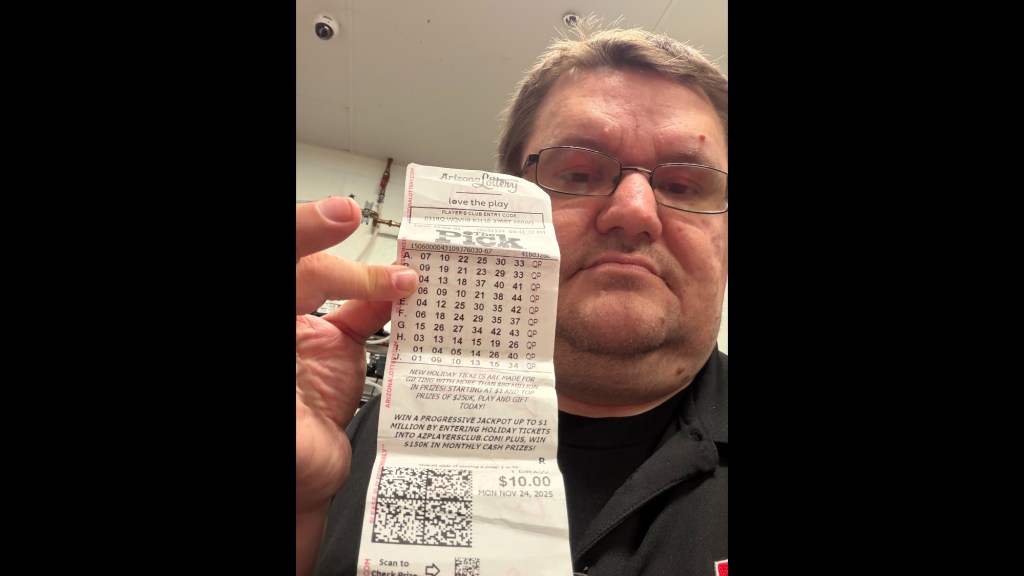
Provided by Joshua Kolsrud
‘Why tell me it was OK?’
Whatever one might think of his maneuvers to buy what he knew was a winning lottery ticket, Gawlitza doesn’t fit the stereotypical image of an inveterate schemer.
He’s 44 years old and soft-spoken, bookish and bespectacled. Though he certainly hasn’t abandoned his claim to the ticket and the $12.8 million it promises, at several points throughout a half-hour interview, he seemed just as eager to put the whole episode behind him as he is to come out on top.
He insists that not once after buying the ticket — not even for a moment — did he think to himself, I’m rich! “I don’t like jumping ahead that far,” he said. Text messages included in his court filing both support that claim and read like ass-covering.
In a message to his supervisor, sent alongside a screenshot of a news report showing his store had sold the winning ticket, Gawlitza pointedly asked if it was OK to clock out, change out of uniform and purchase a lottery ticket. Only after being told yes did Gawlitza reveal that he’d already done so, and that the ticket he’d purchased was the $12.8 million winner from the night before. “I ask because the winning ticket was sitting in my store and for the 12.8 million winner and that is what I just did,” he wrote. He then asked about the procedure for notifying Circle K.
For the next few hours, Gawlitza told New Times, everything seemed fine. Then the tone shifted. Circle K now had lots of questions about his purchase — how the ticket had been printed, how he’d bought it. He offered to take it to the company’s Tempe headquarters, but was told in no uncertain terms to stay put. Someone would come to retrieve the ticket. Gawlitza said Circle K also sent someone to check if the store’s lottery machine had been tampered with. It hadn’t.
Gawlitza began to get concerned. He’d put those coworkers’ names on the ticket to split the prize with them — one is a co-claimant in his court filing — and now he worried he’d placed them in a much different kind of jackpot.
“I had all these different people who were going to be affected by this when I was told it was OK,” he said. “If it wasn’t OK, why tell me it was OK?”
He’d only followed procedure, he says, and in more ways than one. Central to his claim is what Gawlitza said was an unwritten but strictly enforced Circle K policy that requires that, after lottery drawings, any printed-but-unsold lottery tickets be purchased at employees’ expense. Because Circle K pays the Arizona Lottery a fee for each printed ticket, the idea is to incentivize employees to avoid printing them unnecessarily. “The lottery is considered cash,” Gawlitza said. Circle K doesn’t want to be too short at the end of the day. If more than $20 of unsold tickets remained after a drawing, he said, employees had to pay out of their own pockets to buy them.
“It’s your fault they’re there to begin with,” Gawlitza said, explaining the company’s reasoning for the policy. “You didn’t sell them, so why should the company be taking the hit? You made the mistake, so you need to learn the lesson and buy those tickets.”
Six current and former Circle K employees submitted affidavits to the court attesting to the policy’s existence and to the fact that employees who won money after purchasing unsold tickets were allowed to keep the winnings. Gawlitza said he was just following policy when he bought the winning ticket, though that explanation raises a few issues. For one, he never mentioned the unwritten policy in the portions of his text exchange with his supervisor included in the court record. Nor does it seem practical for employees to have to change clothes and clock out every time they bought unsold tickets to avoid the company’s ire. Gawlitza’s attorney, Joshua Kolsrud, would not allow questions about those ambiguities, saying they will have to be resolved in court.
Sanctioned or not, Gawlitza’s ownership of the ticket was short-lived. That day, Circle K sent someone to fetch it from him. He relinquished it, though he still felt like it was his. “I paid for it and had a receipt for it. I was also given permission to buy it,” he said. “I’m following the policy.” He wasn’t sure if he’d ever see the $12.8 million, but he felt confident of one aspect of his ownership stake. “I just didn’t know if I was allowed to claim anything out of it,” he said. “I still felt the paper belonged to me.”
Nonetheless, Circle K spirited it away, and Gawlitza eventually returned to his usual routine. The company would give him periodic updates — We’re working on it, don’t worry — but otherwise, life returned to normal.
Then, on the last day of January, the company fired him. Three weeks later, it filed its lawsuit, publicizing his name and asking a court to sort out ownership.
Even more than on the day he found the ticket, he wasn’t sure what to do.

Gregory Clifford/Getty Images
‘You have a case here’
Gawlitza first learned of Circle K’s lawsuit when a New Times reporter contacted him in February to ask about it. He responded to ask to see the complaint, and then went dark. Multiple subsequent attempts to contact him went unanswered.
Sitting in his attorney’s office and speaking to that same reporter five months later, Gawlitza explained his silence — he’d been scared.
“I could tell you my side of the story, but we don’t hang out,” he said. “I just met you. How do I know you’re really going to tell my side of the story?”
That feeling of unease persisted for months after the lawsuit was filed. Gawlitza felt alone. He leaned on his family and his church, but he felt he had few others looking out for his best interests. Meanwhile, people in Arizona and beyond latched onto the lottery ticket saga, guessing at Gawlitza’s motivations.
For a while, Gawlitza just hoped it would go away. There was a 180-day window for someone to claim the winning ticket, a period set to expire in May. If he kept his head down that long, he thought, the whole controversy would blow over. “I thought, ‘Well, if it’s expired, this is going away and they can leave me alone. This proves I’m not trying to go after the money,'” he said. But then the Arizona Lottery agreed to suspend the claim deadline, a decision that was reinforced by a judge’s ruling. A family friend suggested Gawlitza lawyer up.
Finding a lawyer proved to be tricky and a bit fraught, however. Given the jackpot at stake, one might assume attorneys would be banging on his door with dollar signs in their eyes, but Gawlitza said he received no such inquiries. He had to hunt for an attorney, only to find himself repeatedly misunderstood. None had the expertise for the peculiar circumstances of the case — indeed, even the Arizona Lottery has said the case is unprecedented.
One attorney left him more worried than when he went in. Gawlitza said he met with Suzuki Law Offices, a firm led by attorney Richard Suzuki that advertises itself as a criminal defense and personal injury shop. Though he did not meet with Suzuki himself, Gawlitza said another staff member listened briefly to his version of events, only to cut him off and suggest it sounded like Gawlitza had committed a felony. Gawlitza said the staffer said the firm could attempt a pretrial settlement — there is currently no evidence to suggest Gawlitza is under any type of criminal investigation — and that it would cost him $10,000.
Suzuki Law Offices did not respond to questions about Gawlitza’s claims.
The meeting left Gawlitza baffled. After all, he’d hardly been sneaky about buying the ticket. If he’d been intent on illegally snatching it, “I would have been gone with the ticket right then and there,” he said. “I wouldn’t have still been communicating with Circle K and then handing it over to them.” The consultation also rattled him, leaving him all the more convinced that he needed representation. A family friend suggested he look into Kolsrud.
Kolsrud had been familiar with the case, but he admits that he initially thought the ticket probably belonged to Circle K. To him, it depended on whether Gawlitza knew it was the winner, which he did. “I thought that was the issue,” Kolsrud said. “Did he know it was the winning ticket? If he did, then it’s not his.” But then he met with Gawlitza and heard his version of events, including about the unwritten policy that employees must purchase unsold lottery tickets. His opinion changed.
“After I listened to him, I was like, ‘You have a case here,'” said Kolsrud, who normally practices criminal law. “I’m not an expert in this area, but it seems pretty obvious there’s something there.”

Tony Webster
‘Money helps’
Whether that something pans out remains to be seen. A judge has yet to rule on the issue, and no future court dates have been scheduled. But with an attorney finally in his corner, Gawlitza is intent on pressing his claim.
He has myriad motivations. He felt “thrown under the bus” by Circle K and he wants justice for what he views as his unwarranted firing. He doesn’t like how he’s been portrayed in court filings and in news reports, and he’s hoping to set the record straight. There are precious few in the country with the Gawlitza name — only him and his parents, he said — and the lottery ticket saga has tarnished it. “How they portrayed me in the media was like I had done something wrong,” he said. “That’s what I was trying to get cleared up, and get fixed.”
Though many may find it hard to believe, he claims he’s not angling for the $12.8 million. “I really had no intention of going after this money,” he said. “I just really wanted to clear my name and not have to deal with any legal problems.” That doesn’t explain why he maneuvered to buy it in the first place, clocking out and back into work in a manner that may have complied with the letter of Circle K’s rules but that the company clearly feels abused their spirit. But however the court case ends, Gawlitza said, moving beyond it will be a relief.
“There are more important things in life than money,” he said. “Family’s more important. My faith is more important than money.”
Then he added a caveat, seemingly acknowledging that by hanging with the case, his chance at the jackpot remains alive.
“Money helps. It helps anybody in this world. It helps the world go round,” he said. “But there’s priceless things that are more important to me.”